Project 01
RetroFuse Bolt RC2
Chromium runtime profile and browser foundation
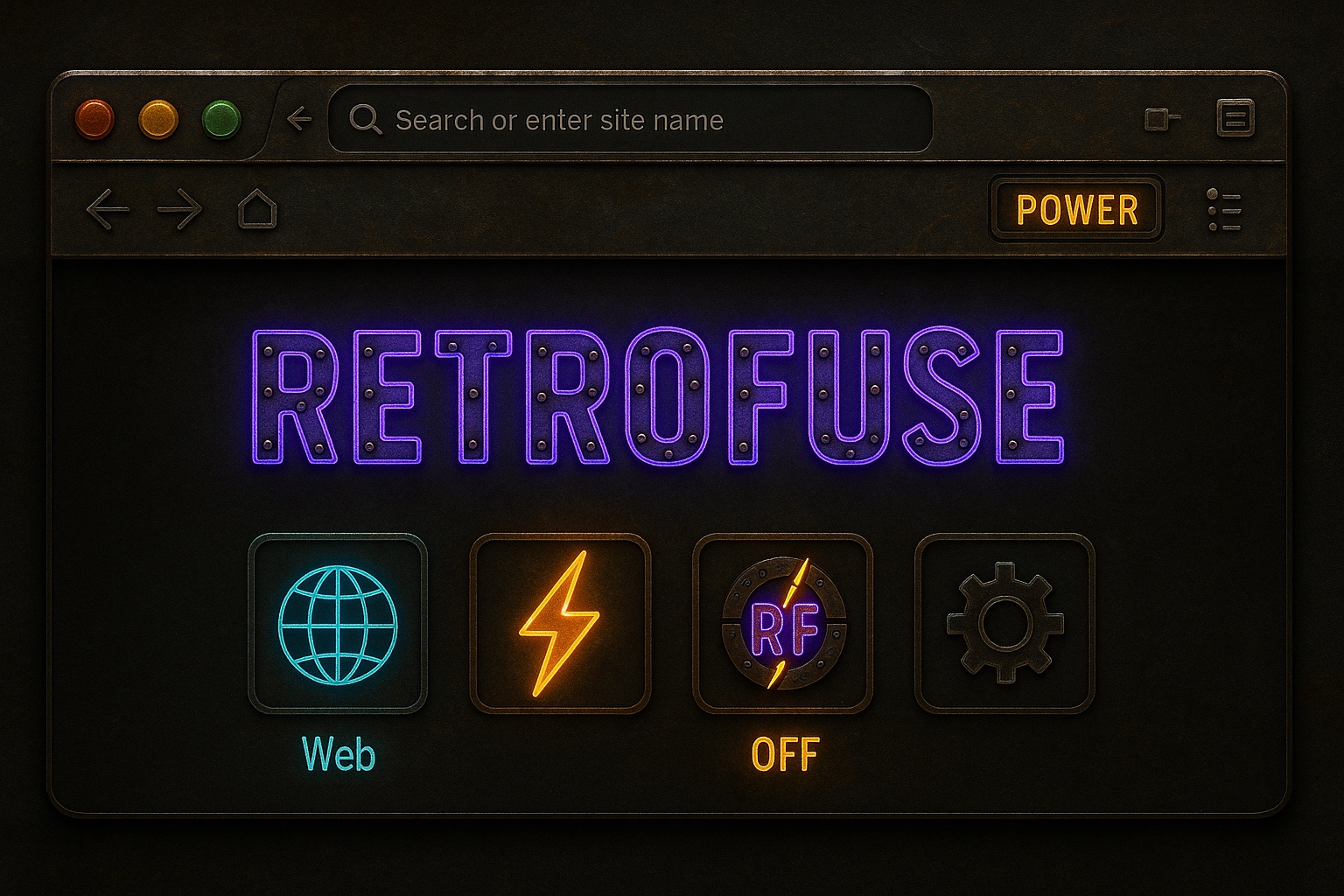
RetroFuse Bolt RC2 is the original ungoogled Chromium browser profile built
around a specific flagset, cache layout, and lean operating posture. In the
wider RetroFuse stack it behaves like a runtime, but the runtime was designed
around the browser first.
The intended pattern is portable: any Chromium-based browser should be able to
run the approach with the right flags and cache locations. Ungoogled Chromium
and Vivaldi are the preferred targets.
Back to the main mission
Project 02
The RetroFuse Governor and His Secretary
Continuous Ops loop for AI browser sessions
The Governor is the active guardian of the browser session. It uses the Chrome
DevTools Protocol to manage modern AI interfaces, reduce browser bloat, recover
from hangs, and archive interaction data while the session is still running.
- Adaptive DOM pruning keeps long AI conversations responsive by replacing older page regions with lightweight stubs.
- Atomic write verification protects local records by hashing, reading back, and renaming completed files safely.
- Gridlock recovery detects stalled AI interfaces and attempts soft recovery without discarding the active prompt.
The Secretary is the continuity agent behind the Governor. It watches the
captured HeartBundles, processes them through local Ollama models, summarizes
meaningful work, and helps move useful material into the project's longer-term
record.
- Backlog escalation can move from faster local models to heavier reasoning models when the queue demands it.
- Batch reasoning groups activity into useful work units instead of treating every line as an isolated event.
- CLI ingestion captures terminal activity alongside browser activity for a fuller development record.
Together they turn a fragile browser tab into a more stable development
environment for long AI sessions: the Governor keeps the session alive and
captured, while the Secretary makes the captured work useful.
Read the operating principles
Project 03
The RetroFuse Daily Bundle System
Verified continuity packages for controlled recovery
The Daily Bundle System preserves operational truth by packaging the current
state of a managed RetroFuse environment into verified daily records. Its job
is to make recovery and review depend on declared state, not guesswork.
Each bundle captures the information needed to understand what changed, what
was running, what was recorded, and whether the state can be trusted. Hashes,
determiners, Control Records, ledgers, and runtime interpretation provide the
authority for restart, audit, and cold-lane rehydration.
In practical terms, it keeps complex work from drifting into ambiguity. If a
system needs to be resumed later, the bundle is the map back to a known state.
Open the release surface
Project 04
The Gen 7 AI/CLI Boot System
Governed AI execution boundary
The Gen 7 AI/CLI Boot System is RetroFuse's controlled entry layer for
AI-assisted command-line work. It routes supported AI CLI tools through shared
boot validation, workspace allowlisting, session capture, and mutation controls
before they operate inside a project environment.
Rather than treating AI assistants as ordinary developer tools, Gen 7 treats
every AI CLI session as an operational event. Sessions are started under
declared authority, constrained to approved roots, journaled for continuity,
and separated into observation or write-authorized modes.
Gen 7 lets RetroFuse use advanced AI tools without letting those tools become
untracked operators inside the system. Codex, Gemini, Copilot, and Ollama are
replaceable engines operating under governance, not the architecture itself.
- RetroFuse philosophy and method define the reason for the work.
- Unity Platform structures the submission.
- DailyBundle and OPS provide continuity authority.
- Gen 7 governs AI tool execution boundaries.
- Project modules contain the domain-specific work.
- AI tools act as replaceable engines under governance.
See the current roadmap